
One of the things I appreciate most about Anchored Tides is the skillful care in which they hold all of their clients. I don't know how they have managed to find an entire team that sees into the deep dignity of every person they treat - this includes strong boundaries and creates a stable and safe environment for healing.
Jona Genova
Read all reviews on Google

Page 6 of 10 · /conditions/anxiety/

Anxiety in women is one of the most common mental health experiences in the country, and one of the most common reasons women begin using substances to cope.

Generalized anxiety, panic disorder, social anxiety, and trauma-driven anxiety all show up in our admissions conversations. If anxiety has become the loudest voice in your day — or if it has quietly shaped what you reach for to get through it — our women's addiction treatment center is a place where the two can be treated as the connected story they are.

TL;DR

Anxiety disorders are roughly twice as common in women as in men, and frequently co-occur with substance use. Treating one without the other is rarely durable. Integrated, evidence-based care — CBT, DBT, mindfulness, and where appropriate, medication — is the path that holds.

Key Takeaways

  1. Anxiety is more than worryit includes generalized anxiety, panic disorder, social anxiety, and trauma-related anxiety.

  2. Women experience anxiety at roughly twice the rate of mena pattern documented across most age groups.

  3. Many substances are used to manage italcohol, benzodiazepines, cannabis, and stimulants — each commonly used to manage anxiety, and each often worsens it over time.

  4. Untreated anxiety drives substance useand is one of the most common reasons recovery doesn't hold.

  5. Treat them together, not in sequenceeffective care addresses anxiety and substance use together — the integration is the medicine.

What it actually means

Anxiety disorders are persistent, disproportionate, and disruptive.

Anxiety, in a clinical sense, is more than the everyday worry that comes with being a person. Anxiety disorders interfere with sleep, work, relationships, and the ability to be present in one's own life. Common conditions include generalized anxiety disorder, panic disorder, social anxiety disorder, and trauma-related anxiety.

Panic disorder, in particular, involves sudden surges of intense fear, often with physical symptoms like racing heart, shortness of breath, or a sense of impending doom. Many women experience both panic and the longer-running undercurrent of generalized worry.

How it shows up in women

Women's anxiety is often invisible from the outside.

Many women describe themselves as high-functioning, organized, and capable — and privately exhausted. What women describe:

  • A nervous system that feels like it's running in the background all the time.
  • Trouble falling or staying asleep, with anxious thoughts most pronounced at night or early morning.
  • Physical symptoms — tight chest, racing heart, GI distress, jaw tension, shallow breathing.
  • Catastrophic thinking, especially about loved ones.
  • Difficulty being still or alone with one's own thoughts.
  • Using a glass of wine, a Xanax, a vape, or a stimulant to manage the volume of internal noise.

What anxiety often looks like

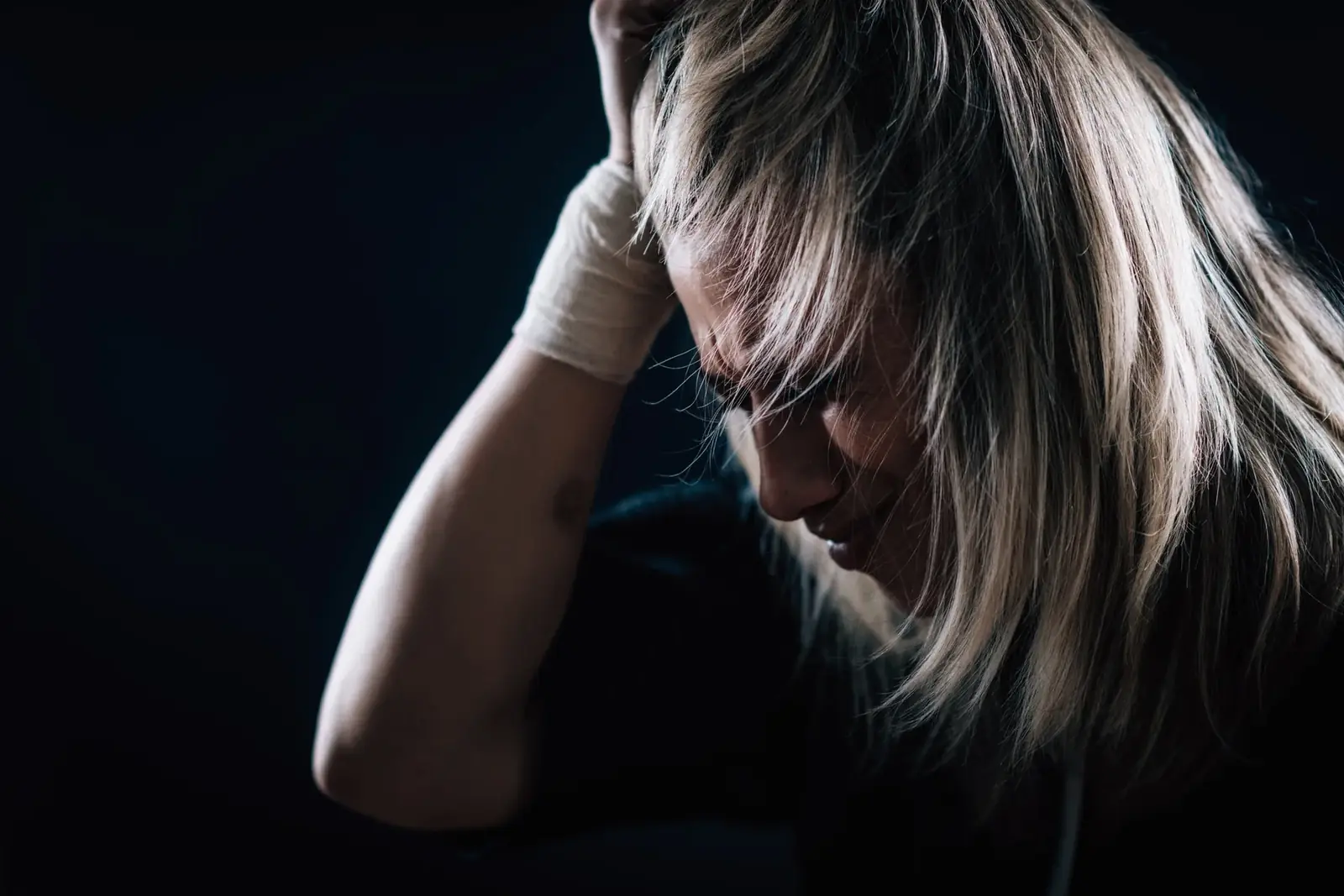
A young woman with arms wrapped around herself, eyes downcast — holding her own weight.

Hormonal shifts across the menstrual cycle, pregnancy, postpartum, and perimenopause can intensify anxiety. Caregiving demand plays a role. And for women with trauma histories, the line between anxiety and the body's trauma response is often blurry.

Why anxiety affects women differently

Roughly twice as common in women — for biological and social reasons.

The National Institute of Mental Health documents that anxiety disorders are roughly twice as common in women as in men. The reasons are complex — biological, hormonal, social, and historical — but the clinical reality is clear: women are more likely to experience anxiety, more likely to be prescribed medication for it, and more likely to layer substances on top of it.

This is part of why women's-only care matters. Hormonal transitions, caregiving dynamics, and trauma history all get treated as part of the picture rather than as background noise.

Causes & co-occurring patterns

Anxiety rarely walks alone, especially in women navigating substance use.

Most women we work with come in with anxiety entangled into other clinical pictures. Our dual diagnosis and trauma-informed care orientations are built for exactly this.

Common contributing factors

Causes & risk factors

  • Family history of anxiety or mood disorders.
  • Trauma history, including childhood adversity, sexual trauma, intimate partner violence, or medical trauma.
  • Chronic stress or caregiving demand.
  • Hormonal transitions — postpartum, perimenopause, thyroid dysfunction.
  • Substance use that disrupts the nervous system over time.
  • Sleep disruption and chronic sleep deprivation.

Patterns we see most often

Co-occurring patterns

  • Anxiety and alcohol — using a drink to take the edge off, then waking up at 3 a.m. with the anxiety multiplied.
  • Anxiety and benzodiazepines — a clinical relationship that often started with a legitimate prescription.
  • Anxiety and cannabis — used for sleep or social ease, often increasing baseline anxiety over time.
  • Anxiety and stimulants — paradoxically using stimulants to function through anxiety, with worsening symptoms downstream.
  • Anxiety and trauma — anxiety sitting inside a broader PTSD or trauma response.
  • Anxiety and eating disorders — anxiety driving restriction, restriction worsening anxiety.

When it's time to reach out

If anxiety has become the background music of your day, that's worth a conversation.

It may be time to talk to someone if any of these are true:

  • Anxiety is the background music of your day, most days.
  • You are using substances — alcohol, benzodiazepines, cannabis, or others — to manage anxiety, sleep, or panic.
  • Panic attacks are part of your experience.
  • You're avoiding situations, people, or responsibilities because of anxiety.
  • Sleep, relationships, or work is suffering.
  • You've tried to manage it alone and the wheels are slipping.

How Anchored Tides supports women

We treat anxiety and substance use as the connected story they almost always are.

Women who come to us with anxiety and substance use are most often supported through our Dual Diagnosis track at the appropriate level of care. Care typically includes:

  • Women's PHP, IOP, or Outpatient — clinical structure matched to the picture.
  • CBT for anxiety, DBT for emotional regulation — the modalities with the strongest evidence base.
  • Mindfulness-based work for the nervous system — alongside group experiences built specifically for women.
  • Coordinated psychiatric care — when medication is part of the picture, prescriber coordination is part of the plan.

In-Network

PPO, HMO, and EPO accepted

Major PPOs Accepted

Out-of-network

Not sure if you’re covered? Verify your insurance in 2 minutes

Frequently Asked Questions

  • Anxiety is a mental health condition, not a substance use disorder — but for many women, the two are deeply entangled. Anxiety often drives substance use, and substance use often worsens anxiety. Treating them together is what makes recovery durable.

Evidence & accountability

Sources and clinical review

This page was reviewed by Zoe Tambling, LMFT on . The references below informed the specific topics noted with each citation.

  1. Anxiety DisordersNational Institute of Mental HealthSupports: Anxiety symptoms and treatment

Ready to take the next step?

A confidential conversation helps figure out where to start — and what treatment should look like for you.

Confidential. No obligation. Most major PPO plans accepted.