
What Dual-Diagnosis Treatment Means for Women — and How to Choose the Right Program
Dual-diagnosis (or co-occurring disorders) treatment addresses substance use and mental health conditions at the same time — becau…
Read articleThe 12 Step program is a spiritually grounded mutual-support framework for recovery from substance use and other compulsive behaviors. It was developed by Alcoholics Anonymous in the 1930s and has since shaped Narcotics Anonymous, Gamblers Anonymous, and many others. Each step is a piece of a larger arc — from honest recognition, through accountability, to service. 12-step works powerfully for some women. For others, a different path or a hybrid approach fits better. Both are legitimate.

You've probably heard about the 12 Steps. Maybe you've sat in a meeting and tried to make sense of language that felt strange or churchy. Maybe you've avoided 12-step altogether because of how it's been described to you. Here's the steps laid out plainly, what each one is actually asking, and how women in recovery tend to experience them — without the marketing, without the gatekeeping, and without pretending it's the only path that works.
The 12 Steps began in 1935 with Bill Wilson, co-founder of Alcoholics Anonymous, who turned his own recovery from alcoholism into a framework. The original program was rooted in Christian spirituality, but the language has evolved — many people in 12-step programs today interpret "a Higher Power" in their own way, religious or not. The same 12-step structure has been adapted by Narcotics Anonymous, Gamblers Anonymous, Heroin Anonymous, Overeaters Anonymous, and many others.
What's stayed consistent: the 12 steps are a sequence. You don't graduate by reading them. You work them, often with a sponsor, over time.
"We admitted we were powerless over alcohol — that our lives had become unmanageable."
Step 1 is about the truth being said out loud. Not as a defeat, but as the end of denial. For most women, this step is harder than it sounds — addiction is built on a long line of small lies to yourself and the people you love. Step 1 is the moment the line stops getting longer.
"Came to believe that a Power greater than ourselves could restore us to sanity."
Step 2 isn't about adopting a specific religion. It's about admitting that doing this alone hasn't worked, and being open to the idea that something larger than you can help — whether that's a spiritual power, the recovery community, the wisdom of the group, or something you can't name yet.
"Made a decision to turn our will and our lives over to the care of God as we understood Him."
This is where the surrender becomes a decision, not a feeling. "God as we understood Him" is the door 12-step opens to interpretation. Whatever you understand that Higher Power to be, the step is asking you to stop trying to control everything.
"Made a searching and fearless moral inventory of ourselves."
A written inventory. Not punishment — clarity. Who you've harmed, where your behavior didn't match your values, the patterns you've been blind to. Most people work this step with their sponsor over weeks or months.
"Admitted to God, to ourselves, and to another human being the exact nature of our wrongs."
You say the inventory out loud, to someone you trust. It's the antidote to shame, which dies in the light. Most women describe step 5 as one of the hardest and most freeing parts of the program.
"Were entirely ready to have God remove all these defects of character."
Acknowledging the patterns is one thing. Being ready to let them go is another. Step 6 sits in the gap between awareness and willingness.
"Humbly asked Him to remove our shortcomings."
Asking, not commanding. The 12 steps consistently return to the idea that the person doing them isn't running the show alone.
"Made a list of all persons we had harmed, and became willing to make amends to them all."
A list. Specific people. The willingness part is doing the work of getting ready to face them, even when you'd rather avoid it.
"Made direct amends to such people wherever possible, except when to do so would injure them or others."
This isn't blanket apology. It's directly addressing harm — financial, emotional, relational — and doing what you can to repair it. The qualifier matters: you don't make amends in a way that hurts the person more.
"Continued to take personal inventory and when we were wrong promptly admitted it."
Step 10 is what the daily practice looks like. Not a one-time inventory — a habit of honesty.
"Sought through prayer and meditation to improve our conscious contact with God…"
Continued spiritual practice. Many women interpret this through meditation, mindfulness, nature, journaling — whatever keeps them connected to something larger than the day's noise.
"Having had a spiritual awakening as the result of these Steps, we tried to carry this message to alcoholics, and to practice these principles in all our affairs."
You help others. You sponsor. You show up. You live the principles outside the meeting room. Many women in long-term recovery say step 12 is where the program stops being something you do and starts being something you are.
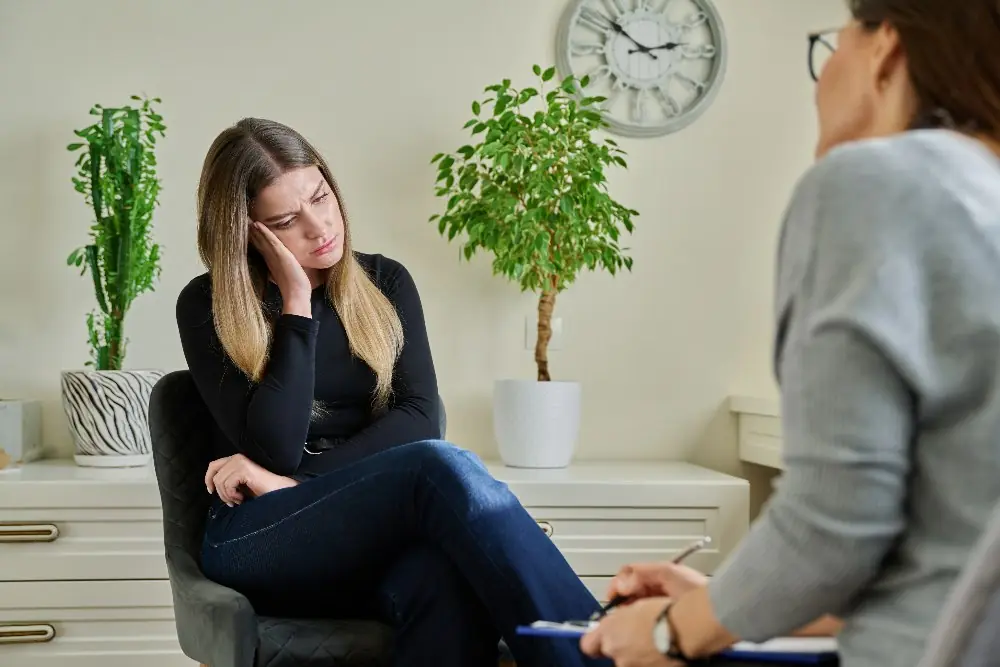
For many women, yes — powerfully. The structure, the accountability, the relationships, the spiritual dimension, the not-being-alone-in-it. There's a reason 12-step has lasted nearly a century.
It's also true that 12-step isn't the right fit for every woman. Some find the spiritual language doesn't resonate. Some need clinical treatment for the trauma underneath the addiction before mutual-help groups can land. Some thrive in non-12-step alternatives like SMART Recovery, Refuge Recovery, or She Recovers. A growing number of women blend both — clinical treatment plus a mutual-help community of some kind.
Here's the honest version: the best path is the one you'll actually walk. We'll help you figure out which that is.
Anchored Tides Recovery is a women's-only outpatient program in Huntington Beach, California. Our clinical work integrates with whichever recovery community fits each woman best.
Whether you're 12-step curious, 12-step weary, or somewhere in between, our team can help you figure out which path fits.
Call (866) 329-6639 or Verify Your Insurance — confidential, no obligation.
Essentially yes — Narcotics Anonymous adapted the AA 12 steps for drug addiction rather than alcohol specifically. The structure, language, and intent are nearly identical; NA's version uses "our addiction" in place of "alcohol" in Step 1. NA also has its own literature (the Basic Text, not the Big Book), its own meeting culture, and its own community. Many women in dual recovery — addiction to both alcohol and drugs — attend both AA and NA meetings.
No. The phrase "a Higher Power as you understand it" is core to how 12-step communities operate today. Many members interpret a Higher Power as the group itself, the wisdom of recovery, nature, or simply "not me running the show alone." If the language feels off, you can attend secular 12-step meetings, or you can use frameworks like SMART Recovery or Refuge Recovery instead.
There's no fixed timeline. Some people work through all 12 in a year. Others spend longer on steps 4–9 because the work goes deep. Many people continue to revisit the steps over time — step 10 is built around the daily practice. Your sponsor's pace and your own readiness drive it, not a calendar.
Yes — and many women find the combination more powerful than either alone. Clinical treatment addresses the trauma, mental health conditions, and behavioral patterns underneath the addiction. 12-step provides the community, accountability, and spiritual structure. They're complementary, not competing.
Try a different meeting, a different sponsor, or a different program first — fit matters. If 12-step still doesn't resonate after honest effort, that's information, not failure. There are evidence-based alternatives, and women have built long sober lives in every one of them.
Evidence & accountability
This page was reviewed by Zoe Tambling, LMFT on . The references below informed the specific topics noted with each citation.
Ready to take the next step?
Call (866) 329-6639 or verify your insurance — confidential, no obligation. Women-only environment, Joint Commission accredited.
Dual-diagnosis (or co-occurring disorders) treatment addresses substance use and mental health conditions at the same time — becau…
Read article
Adventure Therapy uses outdoor and experiential activities — beach experiences, water-based work, group movement in nature — as pa…
Read article
DBT (Dialectical Behavior Therapy) is an evidence-based therapy developed by Dr. Marsha Linehan that teaches concrete skills in fo…
Read article