The Impact of Heroin Addiction on Mothers and Children

babies-born-to-heroin-addicted-mothers
Many people don’t realize how their personal choices impact the people around them. In treatment settings, we have seen families destroyed by addiction; the victims are not always the people who are dealing with the illness. The victims become the loved ones who are most vulnerable. Addiction stems from many sources. Growing up in a toxic environment, sexual trauma, emotional abuse, genetics, peer pressure, etc. For many people, addiction is just in their blood. But there needs to be a catalyst event to turn addictive personalities into people with substance use disorder.  How come so many people get hooked on heroin? The risks and dangers are well known; it’s common knowledge that heroin ruins lives.  What leads people to take that first step to heroin addiction, then?   

The Opioid Epidemic 

Believe it or not, Medical Doctors (MD) are often the cause for most heroin addictions. A car accident, fall, or medical procedure leaves a person in a lot of pain; a doctor then will prescribe an opiate medication to make them comfortable.  The medicine may do its job and take the pain away, but what happens next?  Opiates are highly effective and highly addictive; for this reason, they only get prescribed in limited amounts. It doesn’t take long for your body to become addicted to an opiate. You can quickly develop a dependence, and opiates are known to have some of the most severe withdrawal symptoms of any drug.  You may finish the pills you were prescribed but still be in pain. Now you’re also dealing with extreme discomfort from opiate withdrawal. The combination of pain and extreme discomfort will often cause a person to try to get more pills, legally or illegally.  Pain pills are difficult to come by, and without a prescription, they can be costly. These obstacles result in people turning to heroin. Heroin is still an opiate, so it has many of the same effects, but it’s a lot cheaper and easier to get. Who knew “back pain” would lead to so many people snorting and injecting heroin?   

Heroin Use in Pregnancy

In 2019, about %7 of pregnant women reported using prescription opioid pain relievers. Of those, 1 out of 5 reported abuse (meaning they got them from a source other than a medical supplier or used them for reasons other than pain relief.) Women face unique issues when it comes to addiction and substance abuse. Studies  show that women who use drugs can have problems related to: 
  • Hormones
  • Menstrual cycle
  • Fertility
  • Pregnancy
  • Breastfeeding 
  • Menopause
  Issues become more complicated when the user is pregnant. Heroin use in pregnancy can increase the risk of: 
  • Miscarriage 
  • Migraines
  • Seizures 
  • High blood pressure 
  • Maternal death
  Those are only the effects of the mother. Opiate abuse while pregnant, for unborn babies, has been linked to:   Basically, babies born to heroin-addicted mothers are babies born addicted to heroin.   

Babies born addicted to Heroin?

Just like adults, babies can have drug dependencies. While pregnant, the fetus shares the mother’s internal resources. If a mother is putting heroin into her bloodstream, the baby is getting heroin into their bloodstream too. After the baby is born, it may experience withdrawal symptoms.  Your baby will need to stay in the hospital for five to seven days after being born so the medical staff can monitor it for withdrawal symptoms (NAS). The severity of a newborn child’s withdrawal symptoms depends on the length and frequency of the mother’s drug use and if the child was delivered prematurely.   

Withdrawal Symptoms on Babies Born to Heroin-Addicted Mothers

Symptoms of drug withdrawal in a newborn can develop immediately or up to two weeks after birth and can include:
  • Blotchy skin coloring
  • Diarrhea
  • Irritability / excessive or high-pitched crying
  • Abnormal sucking reflex
  • Fever 
  • Seizures
  • Hyperactive reflexes
  • Stuffy nose and sneezing
  • Slow weight gain
  • Sweating 
  • Trembling
  • Vomiting
  Defects of babies born to heroin-addicted mothers could be long-term or even fatal:
  • Low birth weight
  • Premature birth
  • Small head circumference
  • Sudden Infant Death Syndrome (SIDS)
  When you are pregnant, treatment aims to mitigate withdrawal symptoms, as they can be harmful to your baby. Methadone or Buprenorphine can help ease symptoms, but your baby may still be born experiencing withdrawal symptoms. Children born to mothers who use heroin beyond the first trimester have a 12x greater risk of Sudden Infant Death Syndrome (SIDS) than those unexposed or only exposed in the first trimester of pregnancy. You have to be extremely careful about your health and well-being during pregnancy,  not just to protect your life but the other life inside of you.   

Growing up with a heroin-addicted mother

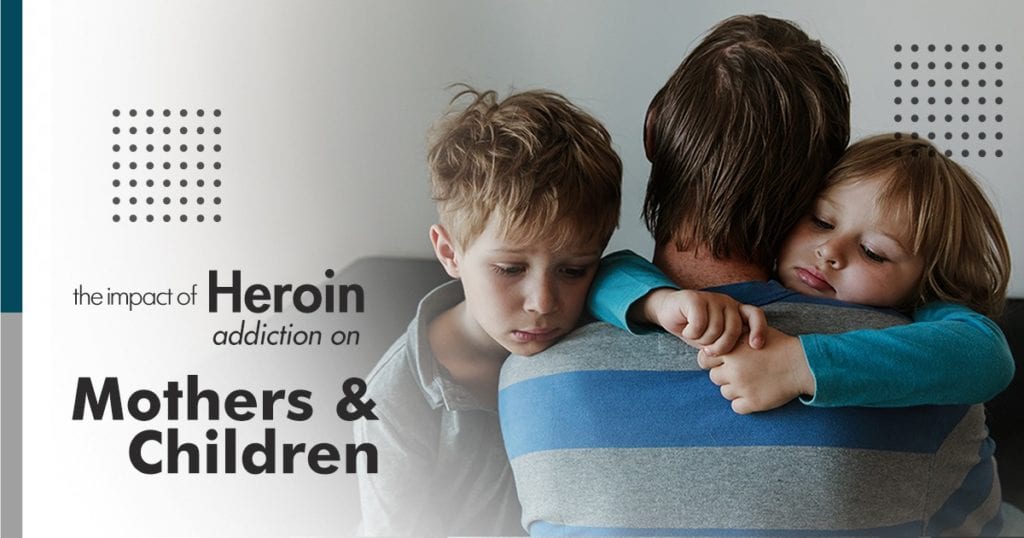
When you are a Mother with a heroin addiction, the roles end up being switched. Your child may be the one who has to take care of you. Children are often manipulated by their mothers when addiction is a factor. They can be asked to get drugs, steal, lie, and cover-up. The sad part is, they think they are helping. They may bear witness to some very traumatic events. They call 911 when you are lying on the ground unresponsive. They cry because they thought that was going to be the last time they saw you. They miss you when you are in rehab. They feel like they are to blame when you relapse. They lose trust and faith in you.  

Effects

What does this pattern of behavior do to this child? 
  • Disappointment
  • Fear
  • Anxiety
  • Emotional trauma 
  • Physical trauma
  • Curiosity 
Amongst all the negative hurt feelings, there is also a sense of exploration and experimentation. Frequently, behavior that is seen is repeated. That is why there is no surprise that children of heroin-addicted mothers are likely to develop addictions or other mental health issues of their own.  

Breaking the Cycle

Loving someone and who is addicted to heroin is challenging. People need to accept help, and you can’t do it for them. You can still love someone without enabling them. Create boundaries, provide resources, say “no” to any requests that support drug use, and use available resources for yourself. Prioritizing your own mental health is critical. If you don’t, the whole family suffers, and ultimately more damage can be done. If you do not have your health or sanity, how can you show strength for the one who needs support? Do you know someone who suffers from heroin addiction?  Are you that Mother or child?  Being open and talking can help. Many times we bottle up our feelings when we need to express them and embrace them. Anchored Tides believes that sharing your experiences in the right environment encourages growth, so we created a gender-specific place where women can heal. We’re not your typical women’s treatment program. Formed in 2016, we offer women struggling with substance abuse and mental illness a haven at our Huntington Beach drug rehab in Southern California. Take a tour of our boutique women’s addiction treatment center in Orange County. Don’t wait any longer. Call us to talk to a healthcare professional. 

The Benefits of a Female Only Treatment Facility for Addiction

Benefits-of-a-Female-Only-Treatment-Facility-for-Addiction

Finding the right addiction treatment for you can be overwhelming. A simple google search can present you with what feels like an endless amount of treatment options. Treatment should be a safe place where you can get honest with yourself and others, be vulnerable, and develop relationships with other sober people.

Addiction manifests in many forms and affects people differently. Addiction can also impact men and women differently. If you’re a woman and looking to get sober, a female-only treatment facility could be a great option for you. At Anchored Tides Recovery, located in Orange County, CA, we’re a female ran and female-only treatment center. It’s safe to say we totally understand women and recovery. 

What is a Women-Only Addiction Treatment Facility?

A women’s only addiction treatment facility is exactly what it sounds like. This is a facility that has been designed specifically to help women who suffer from addiction. During the 1970s and 80s, it came to light that addiction research was historically done on men, therefore the foundation of treatment was ill-equipped for women. As a response to this, research began on the differences between men and women when it comes to addiction. Studies show that:

  • Addiction progresses faster and can be more severe in women
  • Problems related to addiction interfere with functioning in more areas of life than men’s do
  • Are more likely to encounter health-related issues from addiction

After information on how addiction affects genders differently became available, women-only treatment started to form and flourish.

Benefits of a Women-Only Facility

There are numerous benefits to attending a women-only treatment center for addiction.

It’s Easier to Open Up

One of the most important aspects of addiction treatment is opening up to others. People need to be able to share their experiences regarding how addiction has impacted them while also learning from the experiences of others. Women might feel hesitant to open up regarding how addiction has impacted them with other men in the room. In many cases, drug abuse and addiction are going to impact other aspects of someone’s life, including their sexual health. It’s not uncommon for women to have negative sexual experiences during their addiction. It’s important for women to share these experiences in order to cope. 

Find Common Ground

When women enter a treatment facility that is designed for both genders, they might feel like they don’t have a lot in common with the other people in the facility. This can make it hard for someone to come to terms with addiction and rehab. If the treatment center focuses on women, the clients are going to be able to learn from the similarities of others. They are going to feel like they aren’t alone during treatment. Women’s only treatment also sets the foundation for creating a strong sober network. As a woman, it’s important to have support from other women, during and after treatment. 

All Women Staff

At Anchored Tides Recovery, we have an all-female staff. We feel the best way to run a female treatment center is to have females running it. We pride ourselves on creating a welcoming, safe space for women to start their recovery journey. Our female staff understands what you’ve been through while battling addiction and is dedicated to giving you all the tools you need to overcome this horrible disease. We will help you with your addiction and any comorbid conditions such as anxiety, depression, trauma caused by negative sexual experiences or domestic violence, PTSD, and more. 

We Support Women

At Anchored Tides Recovery, we are a comprehensive, dual-diagnosis enhanced program designed specifically for women, by women. Our program offers numerous levels of outpatient services including a Partial Hospitalization Program (PHP), an Intensive Outpatient Program (IOP), a traditional Outpatient Program (OP), and long-term recovery monitoring. We are here to help women overcome addiction and mental health disorders. If you would like to learn more about how our program can help you and your family members recover from addiction, please contact us today!

Women’s Addiction Treatment: Why It’s Necessary

happy-girl-in-meadows

Dealing with treatment and recovery from substance abuse is a hardship for all involved, and that can be compounded by generic programs that don’t take into account the needs of different clients. The fact is, women have a very different path more often than not when trying to pick up again after addiction. Unlike men, women are more frequently in the role of needing to be a direct care provider for children or elders at the same time that they need to address their own mental, physical, emotional and personal needs. As a result, a women-only rehabilitation program is oftentimes a far better approach than a mixed audience option.

Why Women’s Specific Treatment Is Important

Finding addiction treatment specifically geared for women, however, can be challenging. Many programs are geared for all-gender therapeutic treatment and don’t cater to a women-only environment request. And that can leave a patient uneasy or exposed and vulnerable to male clients in the same residential setting. Granted, many programs provide a very high level of security and treatment care for clients and don’t intend to create an unsafe environment. That said, the mixing of vulnerable clients has sometimes been a negative factor in treatment conditions versus an improvement.

The other factor that a mixed audience treatment program can’t directly provide is that women going through similar scenarios may often build bonds in their commonality and strong friends who reinforce each other far better through treatment than any external person could provide them, including medically-trained staff. Those kinds of personal synergies can help a client stay on track, even well after the addiction treatment has ended because the close friendship connection has not.

Is A Women’s Only Rehabilitation Right For You?

There is no one-size-fits-all approach to substance abuse treatment. Regardless of the fact that people are frequently categorized by the type of addiction, demographics and even economic background, people’s situations are fundamentally different from each other when one gets into the details. One situation may very well be a cascading problem of job loss, divorce and family strife contributing to addiction for distraction and trying to get away from the problems. Another situation may be rooted in one’s family history from decades before. Another may be triggered by abusive relationships that act as a catalyst for substance abuse. If a treatment program applied a generic approach to every case coming in the door, a good portion of clients would fail, which is a big problem with many generic treatment providers.

With a women-only rehabilitation center, a patient could very well be a good fit for the gender-specific treatment approach if there is a history of relationship problems with men that act as a catalyst for addictive behavior. In other cases, female patients may be very apprehensive in mixed crowds but in a women-only environment, it becomes easier to open up, which contributes to adjustment and learning versus being defensive. Still, other female clients may want to stay close to their children during treatment and can’t do so in a mixed-gender addiction treatment program. Female clients who find strength in common experience will frequently find benefits in recovering with other women who’ve lived similar lives too.

Women Need Enhanced Rehab Treatment

Many generic programs again only provide the same approach for all patients that come through the door. However, because of the physical toll substance abuse can take, withdrawal effects can be far stronger on women than men. As a result, a second particular aspect female clients or their families need to consider is that the program can address the additional help a female client will likely want or need in the recovery process. These issues often include mental and psychological conflicts of personal worth, sensitivity to groups and societal norms, or fear of the legal system being aggressive towards women in general. Childcare, as mentioned before, is also a big concern for many female patients afraid they might lose their children committing to an addiction treatment program. So, treatment approaches that accommodate mothers are essential to alleviate this fear and reason for not seeking help.

Getting Help That Works

Anchored Tides Recovery is a comprehensive dual-diagnosis enhanced program designed specifically for women, by women. We offer various levels of outpatient services including a partial hospitalization program (PHP), an intensive outpatient program (IOP), an outpatient program (OP), and long-term recovery monitoring with aftercare. If you’re a woman finding treatment for yourself, another female friend, or a loved one, it can be challenging. Call us today. We can help you get the support your need.